Forward Deployed Engineering (FDE): Build Production-Ready AI Applications using Python, FastAPI, LLMs, RAG, AI Agents, Streamlit & Docker – Live Training
Prerequisites:
- Basic knowledge of Python (functions, loops, and data structures) is required. Self-paced recorded videos will be provided for preparation.
- Comfortable with programming logic and problem solving
- Familiarity with JSON and APIs is an added advantage
- A laptop with a development environment set up
Who can enroll for this course:
- Software Engineers (Backend / Frontend / Full Stack)
- DevOps Engineers
- Cloud Engineers (AWS / Azure / GCP)
- System Administrators
- Technical Support / Application Support Engineers
- QA / Test Engineers (Manual & Automation)
- Technical Consultants
- B.Tech / B.E (CSE, IT, ECE, etc.) students
- B.Sc / BCA (Computer Science / IT) students
- MCA / M.Tech students
- Final-year students
- Non-IT professionals with basic programming knowledge and IT understanding
Salient Features:
- 35+ Hours of Live Training along with recorded videos
- 1 Year Access to Session Recordings
- Course Completion Certificate
What will I learn by the end of this course?
- Think and work like a Forward Deployed Engineer (FDE)
- Convert business requirements into technical solutions
- Build production-ready backend services using FastAPI
- Integrate LLM APIs into real-world applications
- Apply prompt engineering techniques effectively
- Build Retrieval-Augmented Generation (RAG) applications
- Develop simple AI Agents capable of performing multi-step tasks
- Build complete AI-powered web applications using Streamlit
- Package applications using Docker
- Design, implement, demonstrate, and present end-to-end AI solutions suitable for real-world business use cases
Course Syllabus:
Module 1: FDE Mindset and Problem Solving (3 Hours)
- What Forward Deployed Engineers (FDEs) do in real-world scenarios
- Understanding business problems and converting them into technical solutions
- Breaking down complex requirements into manageable components
- Understanding constraints and trade-offs
- System thinking: Input → Processing → Output
- Designing practical AI application workflows
Module 2: Writing Production-Ready Python (3 Hours)
- Writing clean, modular Python functions
- Structuring Python projects
- Organizing files and separating logic
- Working with JSON data
- Reading and processing API responses
- Basic exception handling and debugging
Module 3: Backend Development with FastAPI (4 Hours)
- Understanding APIs and Request-Response architecture
- HTTP methods (GET, POST)
- Designing REST APIs using FastAPI
- Working with JSON input and output
- Adding business logic
- API testing using FastAPI Interactive Documentation
- Error handling and validation
Use Case
- Build a backend service with multiple API endpoints.
Module 4: Data Flow in Applications (2 Hours)
- Understanding how data moves through an application
- Using in-memory storage
- File-based storage using JSON
- Reading and writing application data
- Connecting backend APIs with stored data
Use Case
- Extend the backend application to store and retrieve information.
Module 5: AI & LLM Applications (8 Hours)
- Understanding how LLM APIs work
- Prompt structuring and prompt iteration
- Prompt engineering fundamentals
- Understanding variability in model outputs
- Temperature and randomness
- Hallucinations and limitations
- Practical evaluation techniques
- Choosing between Machine Learning and LLMs
- Cost, latency and reliability considerations
Use Cases
1. Email Routing Automation
Students will build an AI-powered email routing system capable of:
- Detecting customer intent
- Categorizing emails
- Routing requests automatically
- Creating structured outputs using LLMs
2. Multimodal AI Application
- Input:
- Product Image
- Output:
- Product Category
Students will learn:
- Image understanding using LLMs
- Prompt-based image classification
- Evaluating classification performance
Module 6: Retrieval-Augmented Generation (RAG) (4 Hours)
- Why LLMs require external knowledge
- RAG architecture and workflow
- PDF ingestion
- Text extraction
- Chunking strategies
- Fixed-size chunking
- Sentence-based chunking
- Recursive chunking
- Embeddings
- Cosine similarity
- Retrieval process
- Context construction
- Generation using retrieved context
- Common RAG failure cases
- Hallucination prevention
Use Case
- Build an end-to-end Document Question Answering System capable of answering questions using information from uploaded PDF documents.
Module 7: Building AI Agents (2 Hours)
- What is an AI Agent?
- Difference between an LLM and an AI Agent
- Understanding agent workflows
- Tool calling concepts
- Decision-making using LLMs
- Designing simple task-oriented AI Agents
- Limitations and best practices
Use Case
- Build a simple AI Research Assistant that can:
- Accept a user query
- Decide which tool or function to use
- Retrieve information
- Generate a final response based on tool outputs
- Students will understand how modern AI Agents combine reasoning with external tools to automate multi-step tasks.
Module 8: UI Integration with Streamlit (2 Hours)
- Building simple user interfaces
- Text input
- Buttons
- Displaying outputs
- Connecting Streamlit with backend APIs
- Connecting Streamlit with AI applications
Use Case
- Build a complete frontend for the AI application developed throughout the course.
Module 9: Packaging with Docker (2 Hours)
- Organizing project structure
- Understanding Docker
- Images vs Containers
- Writing a Dockerfile
- Building Docker images
- Running applications using Docker
- Packaging AI applications for deployment
Use Case
- Package the AI application into a Docker image and run it locally using Docker.
Capstone Project (2 Hours Guided + Additional Work Outside Sessions)
Students will work individually or in groups of 2–3 to design and build a complete end-to-end AI application.
Each project should include:
- Backend API (FastAPI)
- AI/LLM functionality
- Optional RAG or AI Agent capabilities where applicable
- Streamlit User Interface
- Docker packaging (Recommended)
Example Project Ideas:
- Intelligent Resume Analyzer
Customer Support Assistant
Policy Document Q&A System
Contract Review Assistant
Meeting Notes Summarizer
AI Research Assistant
Invoice Information Extraction System
Legal Document Assistant
Customer Feedback Analyzer
Enterprise Knowledge Assistant
Students will:
- Define the problem statement
- Design the system architecture
- Build the complete solution
- Test and evaluate the application
- Present the final project with a live demonstration
Module 10: Watch Python videos for FREE here: (Self-paced recorded videos)
Click here to access and watch the Python videos
Frequently Asked Questions (FAQ’S):
1. Who is this course designed for?
This course is ideal for software developers, data professionals, automation engineers, and anyone interested in building practical AI applications.
2. What are the prerequisites?
Participants should have a basic understanding of Python programming and familiarity with REST APIs.
3. Will I work on real-world projects?
Yes. The course includes hands-on use cases and a capstone project that simulate real Forward Deployed Engineering engagements.
4. Do I need prior experience with AI or LLMs?
No. All core AI, LLM, RAG, and agent concepts are taught from the fundamentals.
5. Will I learn how to deploy AI applications?
Yes. You will package your applications with Docker and learn best practices for production deployment.
6. Are recordings and course materials provided?
Yes. Recordings and supporting materials are shared for revision and self-paced learning.
7. Will I receive a certificate?
Yes. A certificate of completion is awarded to participants who successfully finish the course requirements.
8. Can I showcase the capstone project in my portfolio?
Absolutely. The capstone project is designed to demonstrate your ability to deliver end-to-end AI solutions and can be included in your professional portfolio.
How can I enroll for this course?
OR
For any other details, Call me or Whatsapp me on +91-9133190573
Live Sessions Price:
For LIVE sessions – Offer price after discount is 300 USD 259 109 USD Or USD13000 INR 19900 INR 9900 Rupees
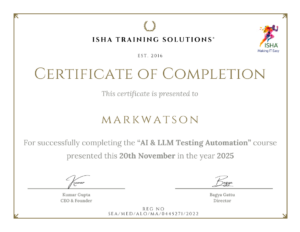
Sample Course Completion Certificate:
Your course completion certificate looks like this……
Note:
To maintain the quality of our training and ensure a smooth learning experience for all participants, we do not allow batch repetition or switching between courses.
To reiterate, moving from one course to another or shifting from one trainer to another (even if it is the same course) is not possible. Changing batches or trainers in any form is strictly not permitted.
We request all learners to attend the scheduled sessions regularly and make the most of their learning journey. Thank you for your understanding and continued support.
Course Features
- Lectures 70
- Quiz 0
- Duration 35 hours
- Skill level All levels
- Language English
- Students 0
- Assessments Yes
- 10 Sections
- 70 Lessons
- 35 Hours
- Module 1: FDE Mindset and Problem Solving (3 Hours)6
- 1.1What Forward Deployed Engineers (FDEs) do in real-world scenarios
- 1.2Understanding business problems and converting them into technical solutions
- 1.3Breaking down complex requirements into manageable components
- 1.4Understanding constraints and trade-offs
- 1.5System thinking: Input → Processing → Output
- 1.6Designing practical AI application workflows
- Module 2: Writing Production-Ready Python (3 Hours)6
- Module 3: Backend Development with FastAPI (4 Hours)7
- Module 4: Data Flow in Applications (2 Hours)5
- Module 5: AI & LLM Applications (8 Hours)9
- 5.1Understanding how LLM APIs work
- 5.2Prompt structuring and prompt iteration
- 5.3Prompt engineering fundamentals
- 5.4Understanding variability in model outputs
- 5.5Temperature and randomness
- 5.6Hallucinations and limitations
- 5.7Practical evaluation techniques
- 5.8Choosing between Machine Learning and LLMs
- 5.9Cost, latency and reliability considerations
- Module 6: Retrieval-Augmented Generation (RAG) (4 Hours)15
- 6.1Why LLMs require external knowledge
- 6.2RAG architecture and workflow
- 6.3PDF ingestion
- 6.4Text extraction
- 6.5Chunking strategies
- 6.6Fixed-size chunking
- 6.7Sentence-based chunking
- 6.8Recursive chunking
- 6.9Embeddings
- 6.10Cosine similarity
- 6.11Retrieval process
- 6.12Context construction
- 6.13Generation using retrieved context
- 6.14Common RAG failure cases
- 6.15Hallucination prevention
- Module 7: Building AI Agents (2 Hours)7
- Module 8: UI Integration with Streamlit (2 Hours)6
- Module 9: Packaging with Docker (2 Hours)7
- Capstone Project (2 Hours Guided + Additional Work Outside Sessions)2