AI & LLM Testing : GenAI, RAG, Security & CI/CD Integration – Live Training
(Master AI & LLM Testing with hands-on experience in GenAI, RAG, automation frameworks, security testing, and CI/CD integration through real-world projects).
AI & LLM Testing: GenAI, RAG, Security & CI/CD Integration is a comprehensive, industry-focused program designed to equip learners with the skills required to test, validate, and automate modern AI applications.
This course takes you from the fundamentals of Artificial Intelligence and Large Language Models (LLMs) to advanced testing strategies used in real-world Generative AI systems. You will gain a strong foundation in Natural Language Processing (NLP), understand how models like GPT work, and learn how to handle non-deterministic AI outputs effectively.
With a strong emphasis on hands-on learning, the course covers Python programming, Object-Oriented design, and API integration to build scalable AI test automation solutions. You will explore critical AI failure modes such as hallucinations, bias, and model drift, and learn how to design robust test strategies that ensure reliability, safety, and compliance.
The program goes deeper into evaluation techniques by introducing semantic metrics like faithfulness, relevance, and safety scoring, along with advanced concepts like LLM-as-a-Judge. You will also work with industry tools and frameworks such as DeepEval and Promptfoo to automate AI testing workflows.
A key highlight of this course is testing RAG (Retrieval-Augmented Generation) systems, where you will learn to evaluate context relevance, groundedness, and response accuracy. Additionally, you will gain practical experience in AI observability using tracing tools, performance monitoring, and token analysis.
The course also focuses on AI Security and Red Teaming, where you will simulate prompt injection attacks, jailbreaks, and data leakage scenarios to understand system vulnerabilities.
Finally, you will learn how to integrate AI testing into modern DevOps practices using CI/CD pipelines, handling non-deterministic outputs, and implementing intelligent test gating strategies.
The program concludes with a real-world capstone project, where you will design and implement a complete end-to-end AI testing framework for a production-grade application, combining all concepts learned throughout the course.
About the Instructor:
|
Arya is an AI Engineer Associate with approximately 5+ years of hands-on experience in the AI and software engineering domain. He specializes in building and working with Large Language Models (LLMs), GenAI applications, and automation-driven AI solutions, with a strong focus on real-time implementation and practical problem-solving. In his professional journey, he has contributed to real-world AI projects, including document intelligence systems, LLM integrations, and AI workflow automation. His experience involves testing and validating AI systems, handling non-deterministic model behavior, and ensuring accuracy, reliability, and performance through structured AI Quality Engineering practices. As a trainer, Bharatkumar is known for delivering practical, industry-focused sessions with real-time examples, hands-on demonstrations, and interactive learning approaches. He simplifies complex concepts like prompt engineering, LLM testing, and GenAI validation techniques, making them easy to understand even for beginners. |
Sample Videos:
AI & LLM-Live Training – Demo Recording
Live Sessions Price:
For LIVE sessions – Offer price after discount is 300 USD 259 109 USD Or USD13000 INR 12900 INR 8900 Rupees
OR
Free Demo On:
Indian Timings: 15th April @ 9 PM – 10 PM (IST)/
U.S Timings: 15th April @ 11:30 AM – 12:30 PM (EST)/
U.K Timings: 15th April @ 4:30 PM – 5:30 PM (BST)
Class Schedule:
For Participants in India: Monday to Friday @ 9 PM – 10 PM (IST)
For Participants in the US: Monday to Friday @ 11:30 AM – 12:30 PM (EST)
For Participants in the UK: Monday to Friday @ 4:30 PM – 5:30 PM (BST)
What students have to say about Arya :
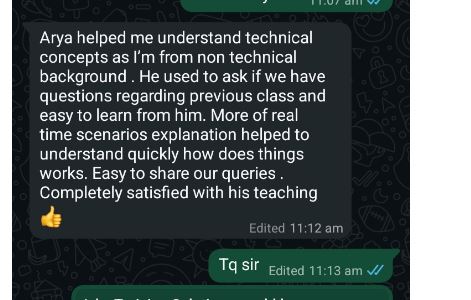
| 👨Arya helped me understand technical concepts as I’m from non technical background. He used to ask if we have questions regarding previous class and easy to learn from him. More of real time scenarios explanation helped to understand quickly how does things works. Easy to share our queries. Completely satisfied with his teaching 👍 – Manogjna
👨 Arya is an exceptional trainer with strong expertise in AI and LLM testing. He covered everything from basics to advanced topics like RAG and CI/CD. His teaching made it easy to apply concepts in real projects.— Rahul 👩 I liked how the course covers not just testing, but also AI risks, security, and red teaming. Very unique and advanced content. — Divya 👨 I really enjoyed learning from Arya. His explanation of GenAI evaluation, prompt engineering, and automation was excellent. This course helped me gain confidence in AI testing. — James 👩 This course helped me upgrade from manual testing to AI automation. The CI/CD integration part was very useful for real-time projects. — Yui 👨 Arya’s teaching style is very clear and engaging. He explained complex topics like AI security and hallucination testing very effectively. 👩 Because of the trainer’s guidance, I was able to complete the capstone project confidently and understand end-to-end AI testing. — Sophia |
Salient Features:
- 30 Hours of Live Training along with recorded videos
- Lifetime access to the recorded videos
- Course Completion Certificate
Who can enroll for this course?
- Software Testers (Manual & Automation) who want to upgrade to AI & LLM Testing
- QA Engineers looking to learn GenAI testing and automation frameworks
- Developers (Python / Full Stack / Backend) working with APIs and AI applications
- AI / ML Enthusiasts interested in LLM, RAG, and Generative AI systems
- Data Analysts & Data Scientists focusing on AI output validation and evaluation metrics
- DevOps Engineers who want to integrate AI testing into CI/CD pipelines
- Cybersecurity Enthusiasts interested in AI security, prompt injection & red teaming
- Students & Fresh Graduates aiming to start a career in AI Testing & Automation
- Professionals looking to transition into AI Quality Engineering roles
- Anyone interested in learning real-world AI, LLM, and GenAI testing concepts
What will I learn by the end of this course?
- Understand AI, LLM, and Generative AI fundamentals and how modern AI systems work
- Gain knowledge of NLP concepts like tokenization, embeddings, and transformers
- Learn Python programming for building AI test automation scripts
- Develop skills in Object-Oriented Programming (OOP) for scalable test design
- Work with APIs and JSON data to test LLM-based applications
- Identify and test AI failure modes like hallucinations, bias, and model drift
- Apply evaluation metrics such as faithfulness, relevance, and safety scoring
- Implement LLM-as-a-Judge techniques for automated output evaluation
- Build automated test cases using DeepEval and Pytest frameworks
- Perform prompt engineering testing using tools like Promptfoo
- Understand and test RAG (Retrieval-Augmented Generation) systems
- Evaluate context relevance, groundedness, and answer accuracy in AI responses
- Monitor AI systems using observability, tracing, and performance metrics
- Create and manage test datasets (Golden Sets) and synthetic data generation
- Learn AI security testing including prompt injection and jailbreak attacks
- Perform red teaming to identify vulnerabilities in AI systems
- Integrate AI testing into CI/CD pipelines using GitHub Actions
- Handle non-deterministic AI outputs in automated testing environments
- Build end-to-end AI testing frameworks for real-world applications
- Complete a capstone project simulating real industry AI testing scenarios
Course Syllabus:
Module 1: Introduction to AI and Large Language Models
- The AI Landscape: Tracing the evolution from traditional Machine Learning to modern generative LLMs.
- Under the Hood of AI: Understanding Natural Language Processing (NLP) fundamentals, including tokenization, embeddings, and transformer architectures.
- Model Architectures: A high-level overview of leading foundational models like GPT, Claude, and LLaMA.
- The Probabilistic Mindset: Learning to navigate and set expectations for non-deterministic outputs.
- Hands-On Application: Prompting basic models via web interfaces to observe non-deterministic behavior and setting up API keys for programmatic access.
Module 2: Python Foundations for Test Automation
- Environment Setup: Professionally configuring IDEs (VS Code/PyCharm) and isolating dependencies using Python virtual environments (venv) and pip.
- Core Python Mechanics: Mastering variables, data types, and control flows (if/else, for/while loops).
- Data Structures: Deep dive into Lists, Dictionaries, Tuples, and Sets—crucial for managing test data and JSON payloads.
- Functions & Modularity: Writing reusable functions, handling arguments, and understanding variable scope.
- Hands-On Application: Writing modular Python scripts to read, filter, and modify lists of sample prompts and expected outputs.
Module 3: Object-Oriented Programming (OOP) & API Integration
- OOP Fundamentals: Understanding Classes, Objects, Attributes, and Methods in Python.
- Inheritance & Abstraction: Building base test classes and extending them for specific LLM models (e.g., a generic LLMTester class extended into OpenAITester).
- API Interactions: Using the Python requests library to send GET/POST requests to REST APIs.
- Data Serialization: Parsing and manipulating complex JSON structures returned by LLMs.
- Hands-On Application: Building a custom Python class that initializes an API connection, sends a prompt, and cleanly returns the formatted JSON response
Module 4: Unique Risks and AI Failure Modes
- Anatomy of AI Failures: Deep dive into hallucinations, overconfidence, model drift, and systemic bias.
- Multidimensional Testing: Defining functional, safety, ethical, and performance testing specific to AI applications.
- Compliance & Security: Navigating data privacy concerns, PII leakage, and basic regulatory compliance in AI outputs.
- Hands-On Application: Engineering adversarial prompts specifically designed to force the model into hallucinating, and documenting the failure patterns.
Module 5: Evaluation Metrics for GenAI Outputs
- Deterministic vs. Probabilistic Evaluation: Moving past exact string matching (Regex/Asserts) to semantic evaluation.
- Core Quality Metrics: Measuring and scoring faithfulness (factual consistency), answer relevance, and context precision.
- Safety & Alignment Metrics: Tracking toxicity, bias scores, and refusal rates (when the model safely declines to answer).
- LLM-as-a-Judge: Using a superior model (like GPT-4) to grade the outputs of a production model based on specific rubrics.
- Hands-On Application: Building a Python scoring engine that utilizes a judging model to evaluate and grade a dataset of AI responses.
Module 6: Automating LLM Tests with Frameworks
- Introduction to DeepEval: Setting up the framework for comprehensive, automated LLM output grading.
- Writing Test Cases: Structuring test suites using Pytest alongside DeepEval metrics.
- Prompt Engineering Testing: Utilizing Promptfoo to create robust YAML-based assertions for prompt iterations.
- Hands-On Application: Writing complete DeepEval test suites and creating dynamic Promptfoo assertion files for a sample generative application.
Module 7: Testing RAG (Retrieval-Augmented Generation) Architectures
- Understanding RAG: The architecture of vector databases, embeddings, and context retrieval.
- The RAG Triad: Evaluating Context Relevance, Groundedness (Faithfulness), and Answer Relevance independently.
- The RAGAs Framework: Integrating the RAGAs Python library to specifically evaluate retrieval pipelines.
- Hands-On Application: Building an automated test suite that identifies whether a bad AI response was caused by a hallucinating model or a poor database search query.
Module 8: AI Observability and Tracing
- The Need for Tracing: Understanding the black box of multi-step agentic workflows.
- LangSmith Integration: Setting up LangSmith to trace token usage, latency, and step-by-step logic.
- Performance Profiling: Measuring time-to-first-token (TTFT) and system scalability under load.
- Hands-On Application: Instrumenting a Python LLM script with tracing decorators to monitor execution paths and token costs in a dashboard.
Module 9: Test Data Engineering & Golden Sets
- The Golden Dataset: Defining and curating a “ground truth” dataset for regression testing.
- Synthetic Data Generation: Using LLMs to automatically generate variations of test prompts to scale test coverage.
- Managing Edge Cases: Designing datasets specifically tailored to trigger boundary conditions and failure modes.
- Hands-On Application: Writing a Python script that leverages an LLM to generate 100 diverse, edge-case user queries from a single base scenario to populate a test database.
Module 10: AI Security and Red Teaming
- The Red Teamer’s Mindset: Fundamentals of offensive security applied to Large Language Models.
- Prompt Injections & Jailbreaks: Executing sophisticated attacks to bypass AI safety guardrails (e.g., DAN attacks).
- Data Exfiltration: Simulating attacks to force the AI to leak system prompts or secure context data.
- Hands-On Application: Conducting a live jailbreak testing session against a sandboxed LLM and generating a professional Red Team vulnerability report.
Module 11: CI/CD Pipeline Integration for AI
- Continuous Integration (CI): Connecting automated Python AI tests to platforms like GitHub Actions.
- Handling Non-Determinism in CI: Managing the reality of “flaky” AI tests using dynamic thresholds and retry logic.
- Pipeline Gating: Setting rules for when an AI test failure should block a deployment vs. when it should just trigger a warning.
- Hands-On Application: Architecting and deploying a fully automated GitHub Actions CI/CD pipeline that triggers your DeepEval test suite on every code push.
Module 12: Capstone Project & Real-World Implementation
- System Architecture: Analyzing a sample production AI application (e.g., an AI Customer Support Chatbot).
- End-to-End Test Strategy: Formulating a test plan covering functional logic, RAG retrieval, and security vulnerabilities.
- Hands-On Application (The Capstone): You will independently test the provided AI system.You will build the test dataset (Mod 9), write the OOP evaluation scripts (Mod 3 & 6), integrate them into a CI/CD pipeline (Mod 11), and present a final technical report and live demo for peer review.
FAQ’s –AI & LLM Testing : GenAI, RAG, Security & CI/CD Integration – Live Training
1. What is this course about?
AI & LLM Testing with GenAI, RAG, security, and CI/CD integration.
2. Is this course beginner-friendly?
Yes, it starts from basics and goes to advanced topics.
3. What programming language is used?
Python is used for automation and testing.
4. Will I get hands-on practice?
Yes, every module includes practical sessions.
5. What tools will I learn?
DeepEval, Pytest, Promptfoo, RAGAs, LangSmith, and GitHub Actions.
6. Does this course cover real projects?
Yes, including a final capstone project.
7. Will I learn AI security testing?
Yes, including prompt injection and jailbreak testing.
8. What is RAG?
A method to improve AI answers using external data sources.
9. Is CI/CD covered?
Yes, with real-time pipeline integration.
10. Who can enroll?
Testers, developers, students, and AI enthusiasts.
11. Do I need prior experience?
Basic knowledge is helpful but not mandatory.
12. What will I gain after this course?
Skills to test, automate, and evaluate AI & LLM systems.
How can I enroll for this course?
OR
For any other details, Call me or Whatsapp me on +91-9133190573
Live Sessions Price:
For LIVE sessions – Offer price after discount is 300 USD 259 109 USD Or USD13000 INR 12900 INR 8900 Rupees
Sample Course Completion Certificate:
Your course completion certificate looks like this……

Note:
To maintain the quality of our training and ensure a smooth learning experience for all participants, we do not allow batch repetition or switching between courses.
To reiterate, moving from one course to another or shifting from one trainer to another (even if it is the same course) is not possible. Changing batches or trainers in any form is strictly not permitted.
We request all learners to attend the scheduled sessions regularly and make the most of their learning journey. Thank you for your understanding and continued support.
Reviews:
Course Features
- Lectures 51
- Quiz 0
- Duration 30 hours
- Skill level All levels
- Language English
- Students 0
- Assessments Yes
- 12 Sections
- 51 Lessons
- 30 Hours
- Module 1: Introduction to AI and Large Language Models5
- 1.1The AI Landscape: Tracing the evolution from traditional Machine Learning to modern generative LLMs.
- 1.2Under the Hood of AI: Understanding Natural Language Processing (NLP) fundamentals, including tokenization, embeddings, and transformer architectures.
- 1.3Model Architectures: A high-level overview of leading foundational models like GPT, Claude, and LLaMA.
- 1.4The Probabilistic Mindset: Learning to navigate and set expectations for non-deterministic outputs.
- 1.5Hands-On Application: Prompting basic models via web interfaces to observe non-deterministic behavior and setting up API keys for programmatic access.
- Module 2: Python Foundations for Test Automation5
- 2.1Environment Setup: Professionally configuring IDEs (VS Code/PyCharm) and isolating dependencies using Python virtual environments (venv) and pip.
- 2.2Core Python Mechanics: Mastering variables, data types, and control flows (if/else, for/while loops).
- 2.3Data Structures: Deep dive into Lists, Dictionaries, Tuples, and Sets—crucial for managing test data and JSON payloads.
- 2.4Functions & Modularity: Writing reusable functions, handling arguments, and understanding variable scope.
- 2.5Hands-On Application: Writing modular Python scripts to read, filter, and modify lists of sample prompts and expected outputs.
- Module 3: Object-Oriented Programming (OOP) & API Integration5
- 3.1OOP Fundamentals: Understanding Classes, Objects, Attributes, and Methods in Python.
- 3.2Inheritance & Abstraction: Building base test classes and extending them for specific LLM models (e.g., a generic LLMTester class extended into OpenAITester).
- 3.3API Interactions: Using the Python requests library to send GET/POST requests to REST APIs.
- 3.4Data Serialization: Parsing and manipulating complex JSON structures returned by LLMs.
- 3.5Hands-On Application: Building a custom Python class that initializes an API connection, sends a prompt, and cleanly returns the formatted JSON response.
- Module 4: Unique Risks and AI Failure Modes4
- 4.1Anatomy of AI Failures: Deep dive into hallucinations, overconfidence, model drift, and systemic bias.
- 4.2Multidimensional Testing: Defining functional, safety, ethical, and performance testing specific to AI applications.
- 4.3Compliance & Security: Navigating data privacy concerns, PII leakage, and basic regulatory compliance in AI outputs.
- 4.4Hands-On Application: Engineering adversarial prompts specifically designed to force the model into hallucinating, and documenting the failure patterns.
- Module 5: Evaluation Metrics for GenAI Outputs5
- 5.1Deterministic vs. Probabilistic Evaluation: Moving past exact string matching (Regex/Asserts) to semantic evaluation.
- 5.2Core Quality Metrics: Measuring and scoring faithfulness (factual consistency), answer relevance, and context precision.
- 5.3Safety & Alignment Metrics: Tracking toxicity, bias scores, and refusal rates (when the model safely declines to answer).
- 5.4LLM-as-a-Judge: Using a superior model (like GPT-4) to grade the outputs of a production model based on specific rubrics.
- 5.5Hands-On Application: Building a Python scoring engine that utilizes a judging model to evaluate and grade a dataset of AI responses.
- Module 6: Automating LLM Tests with Frameworks4
- 6.1Introduction to DeepEval: Setting up the framework for comprehensive, automated LLM output grading.
- 6.2Writing Test Cases: Structuring test suites using Pytest alongside DeepEval metrics.
- 6.3Prompt Engineering Testing: Utilizing Promptfoo to create robust YAML-based assertions for prompt iterations.
- 6.4Hands-On Application: Writing complete DeepEval test suites and creating dynamic Promptfoo assertion files for a sample generative application.
- Module 7: Testing RAG (Retrieval-Augmented Generation) Architectures4
- 7.1Understanding RAG: The architecture of vector databases, embeddings, and context retrieval.
- 7.2The RAG Triad: Evaluating Context Relevance, Groundedness (Faithfulness), and Answer Relevance independently.
- 7.3The RAGAs Framework: Integrating the RAGAs Python library to specifically evaluate retrieval pipelines.
- 7.4Hands-On Application: Building an automated test suite that identifies whether a bad AI response was caused by a hallucinating model or a poor database search query.
- Module 8: AI Observability and Tracing4
- 8.1The Need for Tracing: Understanding the black box of multi-step agentic workflows.
- 8.2LangSmith Integration: Setting up LangSmith to trace token usage, latency, and step-by-step logic.
- 8.3Performance Profiling: Measuring time-to-first-token (TTFT) and system scalability under load.
- 8.4Hands-On Application: Instrumenting a Python LLM script with tracing decorators to monitor execution paths and token costs in a dashboard.
- Module 9: Test Data Engineering & Golden Sets4
- 9.1The Golden Dataset: Defining and curating a “ground truth” dataset for regression testing.
- 9.2Synthetic Data Generation: Using LLMs to automatically generate variations of test prompts to scale test coverage.
- 9.3Managing Edge Cases: Designing datasets specifically tailored to trigger boundary conditions and failure modes.
- 9.4Hands-On Application: Writing a Python script that leverages an LLM to generate 100 diverse, edge-case user queries from a single base scenario to populate a test database.
- Module 10: AI Security and Red Teaming4
- 10.1The Red Teamer’s Mindset: Fundamentals of offensive security applied to Large Language Models.
- 10.2Prompt Injections & Jailbreaks: Executing sophisticated attacks to bypass AI safety guardrails (e.g., DAN attacks).
- 10.3Data Exfiltration: Simulating attacks to force the AI to leak system prompts or secure context data.
- 10.4Hands-On Application: Conducting a live jailbreak testing session against a sandboxed LLM and generating a professional Red Team vulnerability report.
- Module 11: CI/CD Pipeline Integration for AI4
- 11.1Continuous Integration (CI): Connecting automated Python AI tests to platforms like GitHub Actions.
- 11.2Handling Non-Determinism in CI: Managing the reality of “flaky” AI tests using dynamic thresholds and retry logic.
- 11.3Pipeline Gating: Setting rules for when an AI test failure should block a deployment vs. when it should just trigger a warning.
- 11.4Hands-On Application: Architecting and deploying a fully automated GitHub Actions CI/CD pipeline that triggers your DeepEval test suite on every code push.
- Module 12: Capstone Project & Real-World Implementation3
- 12.1System Architecture: Analyzing a sample production AI application (e.g., an AI Customer Support Chatbot).
- 12.2End-to-End Test Strategy: Formulating a test plan covering functional logic, RAG retrieval, and security vulnerabilities.
- 12.3Hands-On Application (The Capstone): You will independently test the provided AI system.You will build the test dataset (Mod 9), write the OOP evaluation scripts (Mod 3 & 6), integrate them into a CI/CD pipeline (Mod 11), and present a final technical report and live demo for peer review.