“Full stack Data Science and AI: Beginner Python to Gen AI, Prompt engineering & Agentic AI”-Live Training.
Dive into the world of Artificial Intelligence and Machine Learning with this full-stack, industry-aligned program.
Begin your journey with the foundations of Python programming, mastering essential concepts, data structures, and libraries such as NumPy, Pandas, Matplotlib, and Seaborn. Progress into data analysis, statistics, and mathematics for AI, building a strong analytical base for real-world problem solving. Explore the full spectrum of Machine Learning – from linear and logistic regression to ensemble models, optimization, and hyperparameter tuning.
Advance to Deep Learning with neural networks, CNNs, RNNs, LSTMs, and autoencoders, then move into Natural Language Processing (NLP) and Generative AI, including transformer architectures, LLMs, and Prompt Engineering.
The course concludes with hands-on AI Agent design.
Perfect for beginners and aspiring data professionals, this program provides an end-to-end learning experience- from Python fundamentals to Agentic AI, equipping you with the technical expertise to excel in the evolving AI landscape.
About The Instructor:
| Meenakshi is a passionate AI and Machine Learning educator with over 9 years of experience, including 4 years in top multinational companies and 5 years dedicated to teaching and mentoring aspiring data professionals. With a strong blend of industry expertise and academic insight, she brings real-world relevance to every concept she teaches – making complex AI topics clear, engaging, and practical.
Her mission is to empower students with the confidence and skills to build successful careers in the fast-growing field of Artificial Intelligence. Known for her approachable teaching style and results-driven guidance, Meenakshi creates an inspiring learning environment where students don’t just learn – they grow, innovate, and thrive. |
“AI & ML Unlocked: Beginner Python to Machine Learning & Deep Learning”-Demo Video
“AI & ML Unlocked: Beginner Python to Machine Learning & Deep Learning”-Day 1 Video
Live Sessions Price:
🔥 Exclusive One-Time Offer – Offer price after discount is 282 224 USD Or USD 237 USD25000 INR 21000 INR 19900 Rupees.
OR
Day 4 Session:
9th January @ 9:00 PM – 10:00 PM (IST) (Indian Timings)
9th January @ 10:30 AM – 11:30 AM (EST) (U.S Timings)
9th January @ 3:30 PM – 4:30 PM (BST) (UK Timings)
Class Schedule:
For Participants in India: Monday to Friday @ 9:00 PM – 10:00 PM (IST)
For Participants in the US: Monday to Friday @ 10:30 AM – 11:30 AM (EST)
For Participants in the UK: Monday to Friday @ 3:30 PM – 4:30 PM (BST)
What student’s have to say about the Trainer:
| The trainer demonstrated excellent subject knowledge and delivered the sessions in a very clear and engaging way. The explanations were easy to understand and encouraged participation throughout the class. – Samir Arora
Amazing course! It covers everything from basics to advanced topics. Highly recommended! – John T Great value for money! The practical applications and projects were very helpful. – Anurag Perfect for beginners! The explanations are clear, and the content is comprehensive – Kowsalya I loved the hands-on approach. It made learning AI and ML much easier and more fun! – Sagar This course boosted my understanding of AI and ML significantly. The special offer was a steal – Vasavi Incredible course with detailed content. The price for this quality is unbeatable. – Moksitha |
What will I Learn by end of this course?:
- Python Programming: Gain a solid foundation in Python, mastering data types, loops, functions and data structures like list, dictionaries etc.,
- Data Manipulation & Analysis: Use NumPy and Pandas to clean, transform, and analyze data, perform statistical operations, and handle missing or inconsistent datasets.
- Data Visualization: Create clear and insightful visualizations using Matplotlib, Seaborn, Plotly and HIPLOT
- Exploratory Data Analysis (EDA): Perform univariate, bivariate, and multivariate analysis, identify patterns, correlations, outliers, and gain actionable insights from datasets.
- Machine Learning Techniques: Implement and evaluate algorithms like Linear and Logistic Regression, Decision Trees, Random Forests, Support Vector Machines, Gradient Boosting, XGBoost, CatBoost, K-Nearest Neighbors, and Naïve Bayes. Learn about model evaluation, hyperparameter tuning, feature selection, and handling imbalanced data.
- Deep Learning: Build and train Artificial Neural Networks, Convolutional Neural Networks (CNNs), Recurrent Neural Networks (RNNs), LSTMs, and Autoencoders for tasks like image recognition, sequence modeling, and anomaly detection. Understand activation functions, optimization, backpropagation, regularization, and advanced training techniques.
- Natural Language Processing (NLP): Process and analyze text data with tokenization, stemming, lemmatization, bag-of-words, TF-IDF, Word2Vec, and transformer-based embeddings. Apply sentiment analysis, text classification, and NLP pipelines.
- Generative AI & Large Language Models: Explore transformer architectures, self-attention, positional encoding, and work with open-source LLMs for real-world applications. Learn prompt engineering, fine-tuning, and building AI-powered solutions.
- AI Agents: Develop intelligent AI agents using modern frameworks.
- Capstone & Practical Projects: Apply your learning to real-world datasets and end-to-end projects.
Salient Features:
- 100 Hours of Live Training along with recorded videos
- Lifetime access to the recorded videos
- Course Completion Certificate
Who can enroll in this course?
- Beginners ready to start their journey in AI and ML with hands-on guidance.
- Students seeking to strengthen programming, data science, and analytical skills for academics or internships.
- Professionals looking to transition into high-demand AI and ML roles or enhance their careers with data-driven expertise.
- Data Enthusiasts eager to manipulate, analyze, and visualize data for real-world problem-solving.
- Anyone wanting practical knowledge of AI and ML concepts, building job-ready skills and completing impactful projects.
Course syllabus:
Module 1: Introduction to AI
- Definition and Scope of AI
- Introduction to programming
- Starting with Google Collab
Module 2: Programming with Python – Basics
- Why Python?
- Data Types and Type Conversion
- Variables
- Operators
- Conditional statements
- While Loops
- Infinite While Loops
- Nested While Loops
- Break keyword
- For Loops
- Python Identifiers
- Function
- Inbuilt vs User Defined
- Types of Function Arguments
- Global variable vs Local variable
- Anonymous Function | LAMBDA
- libraries
Module 3: Python-Data Structures and Functions
3.1 List
- List creation to store multiple data-type values
- Retrieving an item from a list
- Item Replacement
- List comprehension
- List mutable concept
- Create nested list
- Functions:
- len(), append(), pop(), insert(), remove(), sort(), reverse()
- Indexing
- Forward indexing
- Backward indexing
- Slicing
- Forward slicing
- Backward slicing
- Step slicing
3.2 Dictionary
- Create a dictionary
- Creating a CSV file from python dictionary
- Keys: Values concept
- Important points about python dictionary
- Retrieving Keys,Values
- Retrieving Key-Value pair together
- Update Dictionary
- Checking whether an item exists in dictionary
- Functions
- len(), keys(), values(), items(), get(), pop(), update(),from_dict(),zip(),clear(),map()
3.3 Tuple
- Tuple creation
- Finding length of Tuple
- Slice a Tuple
- Retrieve items using Tuple indexing
- Tuple immutable concept
- Concatenate Tuples
- Unpacking
- Functions
- len(), count(), index(),sorted(),zip()
- Indexing
- Forward indexing
- Backward indexing
3.4 Set
- Set creation
- Functions
- len(), add(), remove(), pop(), union(), intersection(), difference()
3.5 String Operations
- Common data structure operations on a string
- Create a multiline string
- Creating Patterns in strings
- Zero padding
- F-strings
- Replace a part of a string with another string item
- Mathematical operations inside place holders
- Performance of f-literal vs format()
- Create a well-punctuated string using the escape character
- Functions: strip(),split(),join(),capitalize(),lower(),title(),upper(),istitle(),replace()
Module 4: Numpy
- Importance of Numpy in Data Science
- Creating Numpy Arrays
- From Lists and Tuples
- Using arange(), linspace(), and logspace()
- Using zeros(), ones(),full()
- From Random Numbers: random(),rand(),randn(),randint()
- Array Attributes: shape, size, ndim, dtype, itemsize
- Basics Array Manipulation, Mathematical Operations, Indexing & Slicing
- Functions:
- add(),subtract(),multiply(), divide(),type(),arange(),linspace(),log(),abs(),reshape(),ravel(), flatten()
- Statistics using numpy array
- numpy.mean(), numpy.median(), numpy.std(), numpy.sum(), numpy.min(),corrcoef(),cov()
- Comparing performance of list and array
- Diagonal of a Matrix
- Trace of a Matrix
- Identity Matrix
- Multiplicative Inverse of a Matrix
- Determinant of a Matrix
- Adjoint Matrix
- Parsing, Adding and Subtracting Matrices
Module 5: Pandas
- Introduction
- Series
- Creating Panda Series, Empty Series Object, Create series from List/Array/Column from DataFrame, Index in Series, Accessing values in Series
- Statistical Operations on Series
- NaN Value
- Keywords: Values, index, dtypes, size
- Python List vs Numpy Array vs Pandas Series
- Functions: head(), tail(), sum(), count(), nunique(),sort_values(),value_counts()
- DataFrame
- Introduction to DataFrames
- Creating DataFrames from Lists ,Dictionaries, Arrays
- Creating DataFrames from CSV, Excel, and Other File Formats
- Common Attributes: shape, size, dtypes, index, columns
- Basic DataFrame Methods: head(), tail(), info(), describe()
- Accessing and Modifying Data: loc, iloc
- Adding and Dropping Columns and Rows
- Renaming Columns and Index
- Identifying Missing Data
- Handling Missing Data: fillna(), dropna()
- Replacing Values
- Filtering Data
- Sorting DataFrames
- Applying Functions: apply(), map()
- Grouping Data: groupby()
- Merging and Joining DataFrames
- Concatenating DataFrames
- Setting and Resetting Index
- MultiIndex (Hierarchical Indexing)
- Mathematical and Statistical Operations
- Aggregation Methods: sum(), mean(), count(), nunique(), etc.
- Pivot Tables and Cross-tabulations
- Transpose of a Dataframe
- Inplace Parameter
- The Ampersand (&) Logical Operator
Module 6: Matplotlib
- Introduction to “pyplot”
- Basic Plot Functions: plot(), show(), title(), xlabel(), ylabel()
- Understanding Figures and Axes
- Setting Limits and Tick Labels
- Creating Multiple Plots in a Single Figure using subplots
- Adding Legends to Plots
- Different Types of Plots
- Line plot
- Bar Charts
- Histograms
- Scatter Plot
- Pie Chart
Module 7: Seaborn and Plotly
- Creating Basic Plots with Seaborn
- Setting Styles and Color Palettes
- Plotting with Seaborn
- Categorical Plots: barplot(),countplot(),boxplot() etc
- Distribution Plots: histplot(),pairplot() etc
- Relational Plots: scatterplot(),line plot()
- Regression Plots: regplot()
- Matrix Plots: heatmap()
- Annotation
- Using hue, size, and style for Multi-variable Plots
- Comparison with Matplotlib
Module 8: Exploratory Data Analysis(EDA)
8.1 Introduction to EDA
- Definition and Importance
- Steps in EDA
- Tools (Pandas, Matplotlib, Seaborn, Plotly)
8.2 Data Collection and Preparation
- Loading Data (CSV, Excel, Databases)
- Data Structure Understanding
- Handling Missing Values
- Data Cleaning (Duplicates, Outliers, Standardization)
8.3 Data Profiling
- Summary Statistics (Mean, Median, Mode, Std Dev, Variance)
- Data Distribution
- Data Types and Conversion
8.4 Univariate Analysis
- Frequency Distribution
- Visualizations (Histograms, Bar Plots, Box Plots, Violin Plots, KDE Plots)
- Central Tendency and Dispersion (Range, IQR, Std Dev, Variance)
8.5 Bivariate Analysis
- Relationship Types (Numerical vs Numerical, Numerical vs Categorical, Categorical vs Categorical)
- Visualizations (Scatter Plots, Pair Plots, Heatmaps, Box Plots)
- Correlation (Pearson, Spearman, Kendall Tau)
- Covariance
8.6 Multivariate Analysis
- Techniques (PCA)
- Visualizations (HIPLOT,Pair Plot Matrix, Heatmaps, 3D Scatter Plots)
8.7 Feature Engineering
- Creating New Features
- Encoding Categorical Variables (One-Hot, Label, Target)
- Scaling and Normalization (Standardization, Min-Max Scaling, Robust Scaling)
Module 9: Mathematics
9.1 Linear Algebra
- Linear Equations
- Matrices
- Determinant
- Eigen Value and Eigenvector
- Euclidean Distance & Manhattan Distance
9.2 Calculus
- Derivatives (or Differentiation)
- Partial Differentiation
- Logarithm
Module 10: Statistics
10.1 Descriptive Statistics
- Measures of Central Tendency (Mean, Median, Mode)
- Measures of Variability (Range, Variance, Standard Deviation)
- Quartiles, Percentiles, Interquartile Range (IQR)
- Frequency Distribution Tables
- Histograms and Box Plots
10.2 Probability Basics
- Basic Probability Concepts
- Sample Spaces, Events
- Conditional Probability
- Bayes’ Theorem
- Random Variables and Probability Distributions
10.3 Statistical Distributions
- Discrete Distributions (Binomial, Poisson)
- Continuous Distributions (Normal, Exponential)
- Central Limit Theorem and Sampling Distributions
Module 11: Machine Learning
11.1 Introduction to Machine Learning
- Types of Machine learning: Supervised and Unsupervised
- Discussion on different packages used for ML
- Working on Linear Regression: Understanding the regression technique
- Related concepts: Splitting the dataset into training and validation
- Case study based practical application of the technique on Python
11.2 Simple Linear Regression
- Understanding about linear regression
- Simple linear regression
- Linear Regression Assumptions.
- Best Fit line
- Cost Function
- Loss Optimization, Least squares.
- Gradient Descent Algorithm
- Evaluation Metrics for Regression
- Mean Absolute Error (MAE)
- Mean Squared Error (MSE)
- Root Mean Squared Error (RMSE)
- Mean-Squared Log Error (MSLE)
- R²
- Adjusted R²
- Residual (Error) Analysis
- Homoscedasticity & Heteroscedasticity
- Multicollinearity
- Variance Inflation Factor Math
- Recursive Feature Elimination (RFE)
- Multiple Linear Regression
11.3 Logistic Regression
- What is Logistic Regression?
- Types of Logistic Regression.
- Why not Linear Regression for Classification?
- The Logistic Model. (Sigmoid curve and activation function)
- Interpretation of the co-efficients.
- Decision Boundary.
- Cost Function of Logistic Regression.
- Gradient Descent in Logistic Regression.
- Evaluating the Logistic Regression Model(Classification Metrics)
- Confusion Matrix
- Accuracy
- Precision
- Recall (Sensitivity / True Positive Rate)
- F1-Score
- ROC Curve and AUC
- Classification Report (in Python)
11.4 Support Vector Machine
- Support Vector Machine
- Introduction to Support Vector Machine
- Mathematical Approach
- Theory on hyperplane and kernels
- Kernel function
- Different kinds of kernels
- Practical application on Python
11.5 Decision Tree Model
- Decision Tree
- Introduction to Decision tree
- Types of Decision Tree Models
- Classification
- Regression
- Significance of using Decision Tree
- Decision Tree Training Algorithm
- Entropy
- Information Gain.
- Gini Index.
- Feature Selection & Node Splitting Technique.
- Practical application of Decision Tree on Python
- Decision Tree Feature Importance & Model evaluation.
- Limitations of Decision Tree
11.6 Ensemble Learning : Random Forest Model
- Bagging (Bootstrap Aggregation)
- Types of Random Forest Models
- Classification
- Regression
- Advantages of Random Forest Model over decision trees
- Python Implementation.
- Feature Importance, Model evaluation.
11.7 Ensemble Learning : Gradient Boosting Machine
- Boosting
- Bagging vs Boosting
- Types of GBM Models
- Classification
- Regression
- Python Implementation.
- Feature Importance, Model evaluation etc.
11.8 Ensemble Learning : XGBoost
- Introduction to XGBoost Model – a highly efficient gradient boosting framework.
- Types of Xgboost Models
- Classification
- Regression
- Python Implementation.
- Feature Importance, Model evaluation etc.
- Advantages of XGBoost Model.
11.9 Ensemble Learning : CATBoost
- Introduction to CATBoost Model –
- Types of CATBoost Models
- Classification
- Regression
- Python Implementation.
- Feature Importance, Model evaluation etc.
11.10 Machine learning Model Evaluation & Fine Tuning
-
- Model Evaluation: ROC Curve & AUC
- Benchmarking.
- K Fold Cross Validation
- Stratified K Fold Cross Validation
- Hyperparameter Tuning
- GridsearchCV
- RandomizedSearchCV
- Model Evaluation: ROC Curve & AUC
- HyperOpt – An automated, efficient tool for hyperparameter tuning using Bayesian optimization.
- Model Calibration.
11.11 Probabilistic Learning : Naïve Bayes Model
- Naïve Bayes
- Theory of classification
- Concept of probability: prior and posterior
- Bayes Theorem
- Mathematical concepts
- Limitation of Naïve Bayes
- Practical application on Python
11.12 K-Nearest Neighbours (Classification Algorithm)
- K-Nearest Neighbours
- Concept and theory
- Distance functions: Euclidean, Hamming, Minkowski
- Why should we use KNN?
- Mathematical approach
- Practical application on Python
11.13 K-Means (Clustering)
- Clustering 1D and 2D Data
- Elbow Method and Silhouette Score
11.14 Machine Learning Project Life Cycle
- Stages of AI Project Life Cycle
- Requirements and Scope of Work (SOW)
- Data Collection
- Data Cleaning & Exploratory Data Analysis
- Feature Engineering
- Model Selection & Training
- Model Fine Tuning
- Model Deployment
11.15 Feature Engineering
- Different ways of doing feature engineering
- Feature selection using Correlation
- Feature Selection Using Variance Inflation Factor (VIF) and practical implementation
11.16 Important Elements of Machine Learning
- Multiclass Classification
- One-vs-All
- Overfitting and Underfitting
- Error Measures
- Principal Component Analysis (PCA)
- Statistical Learning Approaches
- Regularization Techniques
- L1 (Lasso) and L2 (Ridge) Regularization
- Role of Regularization in Preventing Overfitting
- Bias–Variance Trade-off
- Feature Scaling Techniques
- Standardization (Z-score Normalization)
- Min-Max Normalization
- When and Why to Scale
- Handling Imbalanced Datasets
- Oversampling (SMOTE) and Undersampling
- Class Weights in Models
- Evaluation Metrics for Imbalanced Data (Precision-Recall Curve, F1-score emphasis)
- Model Interpretability & Explainability (XAI)
- SHAP (SHapley Additive exPlanations)
- Outlier Detection Techniques
- Z-score Meth
Module 12: Deep Learning & Introduction to Advanced Neural Network Architectures
12.1 Artificial Neural Networks
- Introduction to ANN
- Biological Neuron vs Artificial Neuron
- Structural ML vs Deep Learning
- Perceptron
- Perceptron Model
- Activation function
- Neural Network Structure
- Multi Layer Perceptron and Deep Neural Network
- NN Training process/ working details
- Data Preparation
- Weights Initialisation
- Feed Forward Architecture
- Forward Propagation
- Activation Function
- Loss Calculation
- Back Propagation Algorithm
- Chain Rule
- Cost Function
- Gradient Descent Algorithm
- Learning Rate
- Different types of Activation functions
- Sigmoid
- Tanh
- ReLU and its variants
- Softmax Activation
- Other NN Training Concepts
- Over fitting
- Under fitting
- Regularization Techniques
- Dropout Regularization
- L1, L2 Regularization
- Batch Normalization
- Early Stopping
- Optimization algorithms
- Stochastic Gradient Descent
- Adam Optimizer
- Vanishing Gradient Problem.
- Exploding Gradient Problem.
12.2 Convolutional Neural Networks (CNNs)
- Concept of CNN
- Understanding spatial data and feature extraction
- Comparison with fully connected networks
- CNN Architecture
- Input Layer and Image Representation
- Convolutional Layer (Filters, Feature Maps, Kernel Operations)
- Stride and Padding concepts
- Non-linear Activation (ReLU)
- Pooling Layer (Max Pooling, Average Pooling, Global Pooling)
- Flattening Layer
- Fully Connected (Dense) Layer
- Output Layer and Softmax
- Key CNN Concepts
- Feature hierarchy (edge → texture → object)
- 1D, 2D, and 3D convolution
- Implementation of CNN in Python (Keras/TensorFlow)
- Building a CNN Model
- Training and Evaluation on image datasets (e.g., MNIST, CIFAR-10)
- Visualizing feature maps and filters
- Data Augmentation
Module 13 : Natural Language Processing
13.1 Fundamentals of NLP & Text Processing
- Tokenization Techniques
- Tokenization in Spacy
- Text Cleaning (regex, lowercasing, punctuation removal)
- Part-of-Speech (POS) Tagging
- Stemming & Lemmatization
- Stop Words
- Text Representations
- Introduction to Text Representations
- Label and One hot Encoding
- Bag of Words
- TF-IDF
- N-Grams Based Text representations
- Word Embeddings :
- Word2Vec : Continuous Bag of Words (CBOW), Skip Gram.
- Advanced Embeddings : Introduction to Glove, Elmo & Transformer Based Embeddings.
- Use Case : Sentiment Classification with Embedding & ANNs.
13.2 Recurrent Neural Networks (RNN)
- Concept of RNN
- Need for handling sequential / time-series data
- Comparison with fully connected networks
- RNN Architecture
- Input, Hidden, and Output Layers
- Hidden state and recurrence relation
- Unfolding through time
- Types of RNN
- Challenges in RNN
13.3 Long Short-Term Memory (LSTM)
- Concept of LSTM
- Motivation: overcoming vanishing gradient in RNNs
- Introduction to memory cells and gates
- LSTM Architecture
- Cell State and its role in long-term memory
- Forget Gate
- Input Gate
- Output Gate
- Updating hidden and cell states
- Working of LSTM (Step-by-step)
- Mathematical formulation
- Intuition behind gate operations
- Implementation of LSTM in Python (Keras/TensorFlow)
- Comparison: RNN vs LSTM vs GRU
- Use Case : Sentiment analysis/Text classification with LSTM
13.4 Autoencoders
- Concept of Encoder-Decoder
- Encoder-Decoder Implementation with Tensorflow
- Auto Encoders.
- Variational Autoencoders (VAE)
- GAN (Generative Adversarial Networks) – basic introduction
Module 14 : Generative AI, Prompt Engineering & Agentic AI
- Transformer Architecture : Understanding transformer architecture in depth.
-
- Self Attention, Multi Headed Attention.
- Positional encoding
- Transformer Implementation with Tensorflow:
- Machine Translation : English to German translation model implementation.
-
-
-
- Large Language Models (LLMs) :
- Gemma, LLAMA, Mistral, Any other OS LLMs Explorations with Hugging Face.
- Practical Applications: Working with open-source LLMs for real-world use case
- Introduction to Retrieval-Augmented Generation (RAG)
- Introduction to Lang Chain, Lang Graph, llama Index,Langsmith
- Prompt Engineering :
- Principles of Prompt Design
- Few-Shot, Zero-Shot, Chain-of-Thought Prompting
- Advanced prompting techniques for optimal AI responses
- AI Agents: Building intelligent systems and exploring future AI developments
Add ons:
SQL
How can I enroll for this course?
OR
For any other details, Call me or Whatsapp me on +91-9133190573
Live Sessions Price:
🔥 Exclusive One-Time Offer – Offer price after discount is 282 224 USD Or USD 237 USD25000 INR 21000 INR 19900 Rupees.
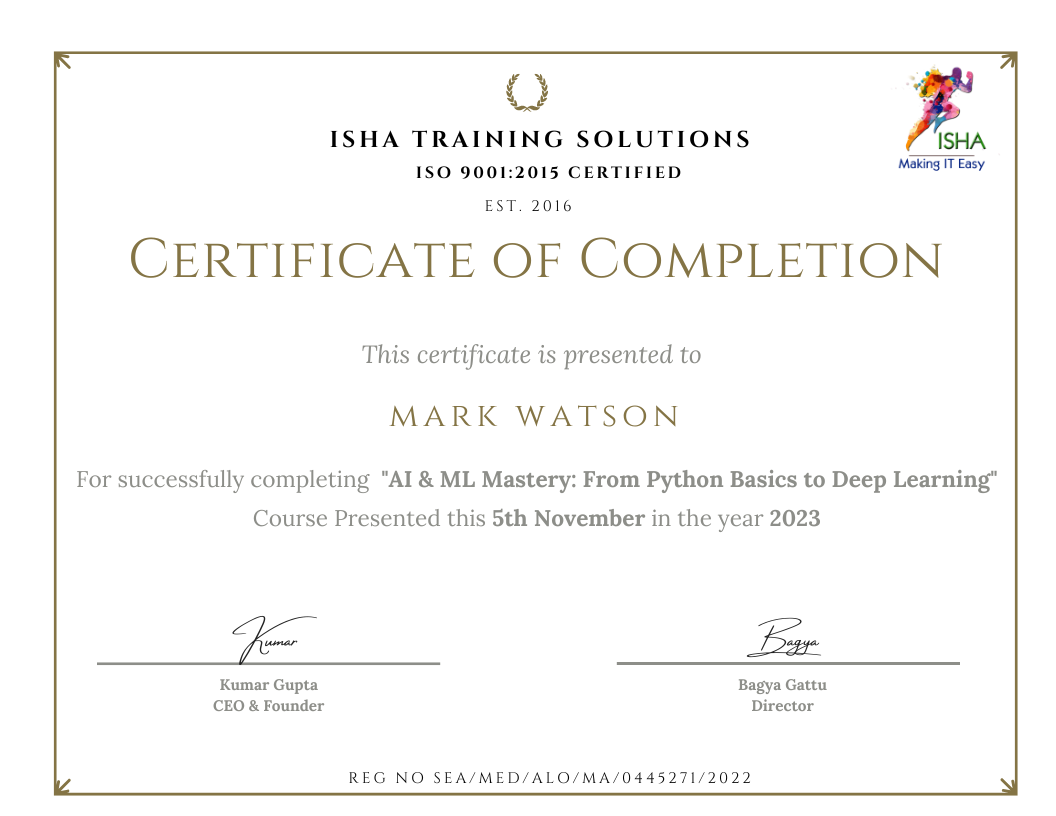
Sample Course Completion Certificate:
Your course completion certificate looks like this……
Reviews: